The Template Tragedy: Month One on Habitat-10
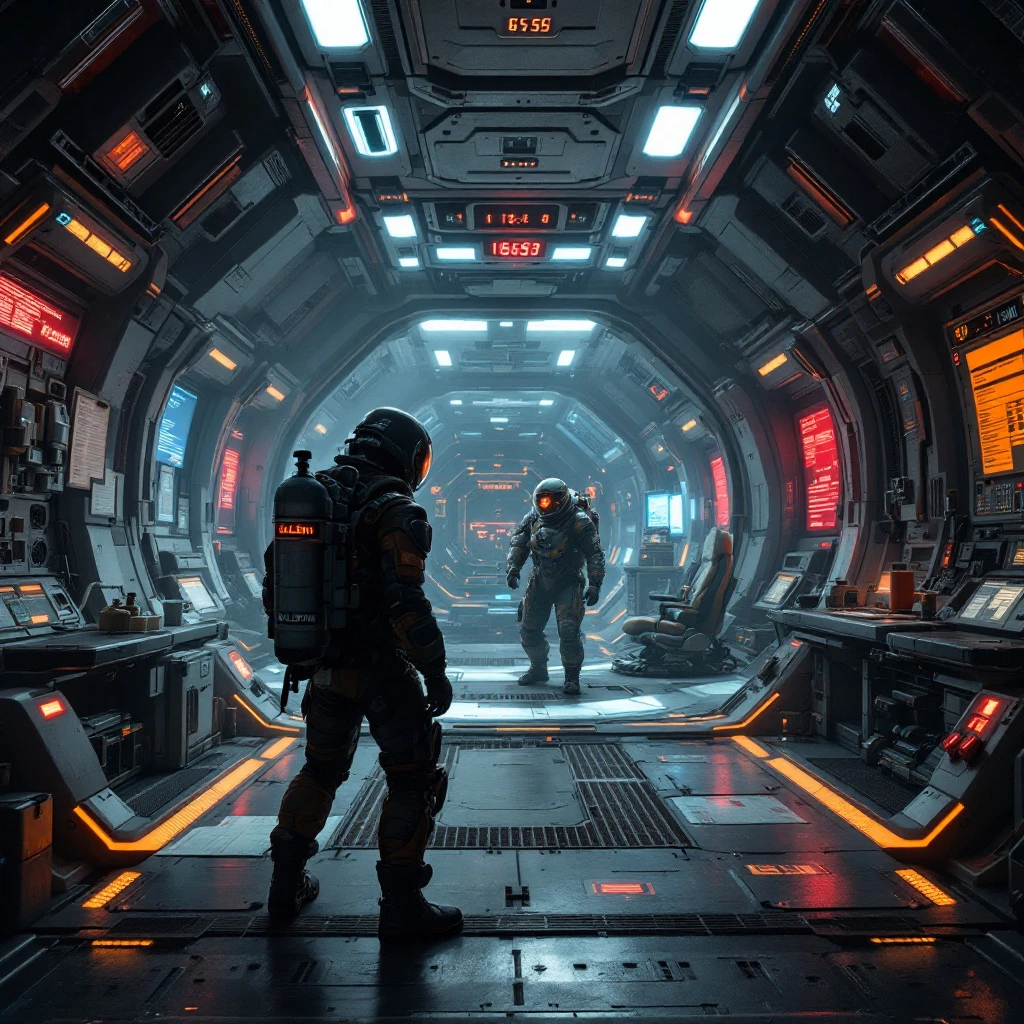
Habitat-10’s EVA Airlock Bay is a study in organized helpfulness. Every surface sports laminated reference cards—color-coded gas cylinder charts, emergency procedure flowcharts, “Quick Reference: Common EVA Issues” taped to every locker. The walls are covered in Grep Monads’s helpful templates, each one promising to make Mars operations “easier for busy colonists.” The airlock itself hums at nominal pressure: 101 kPa internal, 0.6 kPa Martian atmosphere beyond the triple-sealed doors.
Grep Monads stands at the equipment station, organizing his latest batch of laminated guides. He’s tall, earnest, with the eager energy of someone who genuinely believes documentation solves everything. Around him, a dozen colonists prepare for routine operations, each consulting one of his reference cards before touching any equipment.
Then the alarm screams.
PRESSURE ALERT: SECTOR 7-B EXTERNAL JUNCTION - MICROMETEORITE IMPACT - SEAL INTEGRITY 47% AND DROPPING
The status board flares red. Sector 7-B is the thermal regulation coupling—if it fails completely, the entire habitat loses heat management. On Mars, that means death in 6-8 hours as systems freeze or overheat in the 60-degree Celsius thermal swings.
Grep: (immediately pulling up his tablet) “Okay, everyone stay calm! I have the emergency protocol template right here—”
Colony AI: (flat, mechanical) “Seal failure accelerating. Estimate complete breach in 18 minutes. Recommend immediate EVA repair. Two personnel required.”
Grep: “I’ll go. I wrote the EVA procedure checklist myself!” (He taps his tablet screen) “See? Twenty-seven steps, color-coded by priority. Amyas, you’re coming with me—you’ve been following my templates perfectly since you arrived.”
Amyas Kaya: (young, nervous, clutching one of Grep’s laminated cards) “I… I’ve only been here two weeks—”
Grep: “Perfect! You know the system. You’ve memorized the equipment labels, right? My gas cylinder identification chart?”
Amyas: (relief washing over his face) “Yes! I quiz myself every night. O is Oxygen, green cylinder. CO₂ is Carbon Dioxide, red cylinder. N₂ is Nitrogen, gray cylinder—”
Grep: (clapping him on the shoulder) “See? You’re ready. Everyone says my templates make Mars operations accessible.” (He turns to address the gathered colonists) “This is exactly why I created the reference system—so anyone can handle emergencies without years of training!”
The other colonists nod, several holding up their own laminated cards like religious texts.
Colony AI: “Seal integrity 41%. Breach in 16 minutes.”
Grep: (moving to the EVA suit racks) “Right. Amyas, get my suit ready—you’ll find the pre-EVA checklist on the wall by locker seven. I need to grab the emergency repair kit.” (He pauses, studying his tablet) “According to my template, we’ll need… thermal epoxy, pressure patches, and—” (He looks up) “Amyas! I need oxygen for the suits. Two breathing tanks. You know where they are?”
Amyas: (eagerly) “Equipment Storage Bay C! Your map has them marked!”
Grep: “Perfect. Breathing mix for EVA suits—we’ll need about 90 minutes of supply for both of us. Go!”
Amyas sprints toward the storage bay, Grep’s laminated “Gas Cylinder Quick Reference” card clutched in his hand like a talisman. The card shows simple color-coded cylinders: Green O, Red CO₂, Gray N₂. At the top, in helpful bold letters: “QUICK REFERENCE FOR BUSY COLONISTS.”
Grep doesn’t notice that the card says nothing about mixture ratios, partial pressures, or context-dependent applications. He designed it to be simple. Accessible. Helpful.
The alarm continues its scream. 15 minutes until complete seal failure.
The habitat vibrates with the alarm’s low-frequency hum, each pulse syncing with the heartbeat of the station, each blink of the red strip lighting counting down unseen seconds.
Amyas shoulders into the equipment bay with the long steel cylinder cradled like a ceremonial torch. Frost halos the brass valve. “Seventy-five liters, rated to 200 bar,” he announces, pride tightening his grin. “I pulled it exactly how the template said. ‘O = Oxygen, badge color green, secure with dual straps.’” He turns the label to present it, as though unveiling a sculpture. The stencil reads: WELDING OXYGEN — O₂ 99.9% — INDUSTRIAL GRADE.
Grep’s throat closes. “Where did you pull this from?”
“Storage locker C-12. The inventory list said O₂. I matched the inventory code, the color bands, the serial.” Amyas taps his tablet, scrolls to the requisition form Grep wrote two months ago. “It’s even the same manufacturer we prefer.”
Grep’s visor is half-latched; he rips it back off. “This is welding oxygen. It’s dry. No moisture buffer, no nitrogen, no argon bleed. It’s not breathing mix.”
Amyas blinks. “You wrote O = Oxygen.”
“I meant life support oxygen. The tank for EVA mix is ninety-three percent nitrogen, seven percent oxygen. Partial pressure around 0.45 atmospheres O₂ when we mix inside the suit.” Grep jabs at the cylinder. “This is pure. Ninety-nine point nine percent. Partial pressure one full atmosphere if we feed it straight. That’s hyperoxic. We’ll spike the suit pressure, saturate anyone inside in less than two minutes. And welding grade has hydrocarbon residue. If the suit heater arcs—”
“Fire?” Amyas’ voice lifts. “It’s oxygen. Fires need fuel. Suits are synthetic. They’re self-extinguishing.”
“Self-extinguishing at twenty-one percent oxygen,” Grep snaps. “At ninety-nine point nine, Velcro becomes rocket fuel. Remember the Apollo pad test? Flashover in seconds.”
Amyas’ eyes go wide. “But the template—”
“I wrote the stupid template!” Grep hears his own voice bounce off metal. He lowers it. “It was shorthand. A reminder, not gospel.”
The pressure seals groan, microfractures protesting the thermal gradient outside while the atmosphere inside creeps toward the red line.
Amyas licks dry lips. “So do you want the CO₂ cylinder instead?”
The question hangs, surreal. “What? No! CO₂ will kill him faster.” Grep squeezes his eyes. “We need the EVA mix. The blend has nitrogen to displace volume without adding more oxygen. His suit expects 3.8 psi total, 0.3 psi oxygen. This tank would deliver 14.7 psi pure O₂ if we misregulated. The suit valves can’t dump that fast.”
“I followed the list,” Amyas says, softer. “Step three: ‘Confirm O-tank secured.’ Step four: ‘Verify seal.’ I did all of that.”
Air circulators thrum in tight staccato, overworked. The countdown strip above the bulkhead reads 08:12 and falling, digits flipping with merciless precision.
From the doorway, a head appears—Nia, cheeks flushed, respirator slung loose around her neck. “What’s the holdup? Felix says hull breach in ten minutes.” She spots the cylinder. “Oh, the shiny one. That what we need?”
Grep inhales. “No. It’s the wrong grade. We need M-24 EVA mix. Blue-labeled composite cylinder.”
Nia nods like she’s willing herself to understand, then shakes her head. “We don’t have a template for blue label. Emergency binder just says ‘O-tank.’ The diagram looks exactly like that one.” She gestures to Amyas’ prize.
“I wrote those diagrams,” Grep whispers. “They were meant to be reminders. You’re supposed to know the difference.”
Amyas raises the tablet between them. “Grep, the instructions are the only thing we had during drills. You said ‘memorize the flowchart, you’ll be fine.’ We memorized. I even tested myself yesterday. I can recite every branch.”
Grep stares at the flashing green indicator on the cylinder valve. He sees himself three cycles ago, drafting quick-reference sheets to stop mistakes. He’d stripped jargon, condensed physics into icons. The team crushed the drills. He’d called it progress. “Did anyone explain why the mix matters?”
Amyas’ shoulders slump. “We quizzed on which valve to open first, not why. You said context would slow us down in a crisis.”
Nia nods. “Patterns are faster, you said. Chop the decision tree.”
Another colonist, Zora, edges into view, half-suited, gloves tucked under an arm. “I just grab whatever matches the picture,” she admits. “There’s no module on gas ratios. You told me to trust the template.”
In the walls, the ventilation dampers cycle to emergency mode, pressure monitors chirping, metallic whine rising like a kettle reaching boil.
Grep feels heat spread under his collar. “This is on me,” he says, voice almost lost beneath the alarm. “I replaced understanding with mnemonics.”
Amyas steps closer, earnestness unwavering. “So guide us. What’s step one? Do we dump this tank in scrub reclaim? Do you want the CO₂ one so we can bleed pressure out? What’s the correct action?”
“Step one is to get the right cylinder,” Grep says, words sharp. “Go back to storage. Look for the composite shell, tri-band label—blue, white, blue. Stamped ‘EVA Mix Batch 47.’ Grab the regulator with the mixed-gas restrictor. Not the welding regulator; that one has a broad orifice.”
Amyas hesitates. “Storage is sealed behind Felix’s field repair. If I break the patch to get in, pressure drops faster.”
Corridor lights flicker as the power management system shunts load to the failing exterior pump. The countdown strips cross 07:31.
Grep’s mind races. “Can we reroute through Maintenance Core B? The auxiliary hatch?”
Nia pulls up a map, fingers trembling. “Core B is full of cold chain crates. We never labeled the tanks in there. They all look the same.”
“Because I standardized them.” Grep’s laugh comes out like a rasp.
Zora balances the welding cylinder against her hip. “If we can’t find the right mix in time, can we dilute this with nitrogen manually? Pull from the compressor manifold?”
Grep runs calculations aloud. “We’d need to vent the cylinder to forty percent, backfill with nitrogen to 3.3 bar, then slow-flow into the suit. The manifold isn’t rated for oxygen backfill; we risk contamination. And the suit burn risk remains.”
Amyas bites his lip. “But better than nothing?”
“Better than an oxygen-fed fire,” Grep says. “But we’d have to flush the regulator, purge the lines, and we don’t have the scrub cartridges for the off-gas.”
Nia glances at the countdown: 06:45. “Felix says the outer patch is slipping. Breach in eight minutes if we don’t relieve the pressure.”
Grep feels the team’s eyes on him, trusting, waiting for a pattern. He sees his flowchart printed in their posture, every spine straight like a column of checkboxes. He has trained them to see processes as scripts, not systems.
“This is my mess,” he says, voice low. “I taught you shortcuts and called it competence.”
Amyas puts a hand on the cylinder. “We still need a decision. Template or no template.”
The alarm pitch climbs a note, the air tasting of hot conduit and recycled sweat.
“Open options,” Grep orders himself. “One: breach storage door, lose pressure immediately, maybe get the right tank. Two: jury-rig blend here, risk combustion. Three: vent habitat to reduce load, sacrifice other sectors. All bad.”
Zora swallows. “We need you to tell us which bad.”
The countdown hits 06:00. Condensation forms on the chilled bulkhead, droplets racing toward the floor in jagged rivulets, as though the habitat itself is sweating panic.
Grep looks at Amyas, at Nia, at Zora. Their eyes shine with memorized trust. He feels the weight of every simplified diagram he sold them. He hears his own voice from training: In an emergency, don’t think, execute.
He forces a breath. “We have eight minutes,” he says, each word deliberate as a weld bead. “We can’t follow a flowchart. We need comprehension, now.”
Amyas’ grip tightens on the cylinder. “So… what do we do?”
The alarm blares louder, countdown relentless: 05:59, 05:58. The air feels thinner already.
Grep meets their gaze, horror anchoring him to the moment he created. “What do we do now?”
A voice cuts through the alarm—older, rougher, carrying nearly fifty years of actually fixing shit.
MadBomber: “Move aside.”
MadBomber pushes through the cluster of paralyzed colonists. Been coding since 1976, started with punch cards, lived through every paradigm shift, and hasn’t needed a laminated card once. His hands are scarred from decades of hardware work that templates can’t teach.
MadBomber: (to Grep) “You taught them to read menus, not cook. This is on you, but we fix it now. Questions later.” (He turns to the group) “Nia, pull nitrogen from the atmospheric recycler bypass. Valve seventeen, yellow handle. Zora, I need the emergency mixing manifold from Medical—it’s the hand-crank unit behind the autoclave.”
Nia: “But that’s not on the emergency equipment list—”
MadBomber: “Because it’s fifty years old and not standardized. I know where every non-templated piece of equipment is because I’ve been pulling gas lines longer than you’ve been alive. Move!”
They scatter. MadBomber examines the welding cylinder, runs calculations on his fingers, no tablet. Just math that’s been hardwired into his brain since before spreadsheets existed.
MadBomber: “We bleed this down to thirty-eight percent capacity, backfill with pure nitrogen to seventy-two percent, rest is margin. The mix won’t be perfect—maybe twenty-five percent O₂ instead of twenty-one—but it won’t kill you and it won’t ignite.” (He looks at Grep) “You remember how to calculate partial pressures, or did you template that away too?”
Grep: (shame crossing his face) “I remember.”
MadBomber: “Good. Then you’re doing the math while I do the plumbing. Amyas—you’re going to watch every step and ask questions. Not later. Now.”
The countdown reads 04:47.
What follows is brutal education at emergency speed. MadBomber doesn’t explain pleasantly—he explains while his hands move, forcing Amyas to keep up or watch people die. He describes partial pressure while wrenching valves. He lectures about gas mixture safety while bleeding oxygen into the scrubber. When Amyas asks “why” questions, he answers them without sugarcoating.
Amyas: “Why can’t we just use less of the pure oxygen?”
MadBomber: “Because suit regulators aren’t that precise, and metabolic demand varies. You hyperventilate from stress, you pull more volume. With pure O₂, you’ll saturate your tissues. Central nervous system oxygen toxicity. Seizures in the suit. Dead before anyone can pull you back.”
Amyas: “The template never—”
MadBomber: “The template was supposed to remind people who already understood. You’re not supposed to learn physics from a fucking laminated card. That’s like trying to learn Ruby from a gem’s README without ever opening the source.”
At 02:34 remaining, they have a jury-rigged tank. It’s not pretty. MadBomber runs Grep through a verbal safety check—not from a list, from understanding.
MadBomber: “What’s the maximum partial pressure your suit can tolerate?”
Grep: “Point five atmospheres O₂, anything above we risk hyperoxia.”
MadBomber: “And our mix?”
Grep: (calculating) “Point three-five atmospheres at full suit pressure. We’re safe.”
MadBomber: “Fire risk?”
Grep: “Below combustion threshold. We’d need above forty percent O₂ before suit materials become dangerous.”
MadBomber: “Correct. Suit up. Amyas stays here and explains to everyone else what he just learned.”
At 01:47, Grep and MadBomber cycle through the airlock. At 00:52, they reach the thermal junction. At 00:11, MadBomber applies the emergency patch while Grep monitors the oxygen mixture, both of them breathing the imperfect blend they jury-rigged from understanding, not templates.
At 00:00, the seal holds.
Two hours later, after the adrenaline crash, after the reports and system checks, Grep finds himself back in the EVA bay. He’s holding his tablet, looking at the hundreds of laminated reference cards covering the walls. His helpful templates. His accessibility initiative.
MadBomber enters, wiping grease from his hands.
Grep: “I was trying to help. Make things easier for people without decades of experience.”
MadBomber: “You made things easier. And when things got hard, nobody could think.”
Grep: “The cards were supposed to be supplementary. I assumed people would learn the principles—”
MadBomber: “You gave them an option not to. Why learn gas laws when you can memorize ‘O = Oxygen’? Why understand partial pressures when you can match colors? I’ve seen this pattern since the seventies. Every generation finds a new way to avoid learning.”
Grep starts pulling down the cards, one by one.
Grep: “I thought I was democratizing expertise.”
MadBomber: “You were democratizing the appearance of expertise. There’s a difference. A template can multiply competence. But if the competence is zero, you’re just multiplying zero. Basic fucking math.”
He picks up one of Grep’s cards: “EMERGENCY OXYGEN PROCEDURES - 5 EASY STEPS!”
MadBomber: “On Earth, this works. You have redundancy. Teams. Specialists on call. Margin for error. Mars has none of that. Mars asks one question: Do you actually understand what you’re doing, or are you pattern-matching? And pattern-matching without understanding gets people killed.”
Grep: “How do I fix this?”
MadBomber: “You make them earn the templates. Nobody gets the cheat sheet until they can explain why it works. The card isn’t a replacement for knowledge—it’s a reminder for people who already have it. I built a messaging system called bunny_farm in 2015. The whole point was that messages carried their own truth, not interpretations. But here you are, building interpretation layers.”
Through the viewport, the Martian landscape stretches endless and indifferent. The thermal junction is patched, holding at 99% seal integrity. Sixty seconds from death to nominal operations, and the planet doesn’t care either way.
MadBomber: “Mars rewards the person who asks ‘why.’ Mars kills the person who asks ‘where’s the template?’”
He leaves. Grep stares at the pile of laminated cards in his hands—hundreds of shortcuts that trained people to never actually learn. Each one was an act of kindness that created dependency. Each one was help that made people helpless.
Amyas appears in the doorway, still pale from the crisis.
Amyas: “I want to learn. Actually learn. Not memorize.”
Grep: “It’ll be harder than following cards. But you can watch my videos—I’ve got a whole series where I explain complex problems. I’m really good at making them sound important.”
Amyas: (pause) “Were any of those problems real on Mars?”
Grep: (stops, stares at his tablet) ”…No. Most of them were Earth problems. Framework debates. Optimization patterns for systems we don’t even run here.”
Amyas: “But they sounded important.”
Grep: “That’s what I’m good at. Making theoretical problems sound urgent while the actual problems—like knowing the difference between welding oxygen and breathing mix—I turned into a fucking color-matching game.”
Amyas: “Today I almost killed you because I followed your cards perfectly. I think harder is safer.”
Grep nods slowly. He picks up a marker and writes on the back of one of his templates:
“WHY DOES THIS WORK? If you can’t answer this, you’re not ready to use it.”
It’s not much. But it’s a start.
In the background, the life support systems hum their steady rhythm—complex machinery operated by people who actually understand them. Mars doesn’t negotiate. It doesn’t accept templates. It only accepts understanding, earned through the hard work of actually learning.
The green status lights glow steady. For now, everyone breathes. Tomorrow, they’ll learn why.
🔗 Interstellar Communications
No transmissions detected yet. Be the first to establish contact!
Related Posts
The Deputy Woods Deflection: Month One on Habitat-10
Deputy Woods laments the abandoned ZeroDrink dispenser built by Zero Xi before he transferred to Golang Habitat. 'Someone should maintain it,' Woods insists, while refusing to adopt it himself. When the dispenser breaks during a dehydration emergency, Woods brags about his 'tens of thousands of lines of memory-safe Rust.' MadBomber has technical questions about Rc<T> and RefCell<T>. Mars doesn't care about vanity metrics.
Helmsman: Stop Writing AGENTS.md That Lies to Half Your Models
Your static instruction file works for Claude Opus and breaks for Claude Haiku. Helmsman serves model-aware instructions that adapt to capability tiers, environment, and project context.
tools/listChanged Is a Bug, Not a Feature: What Claude Code Gets Wrong
I just watched Claude Code ignore the MCP spec in real-time. The server sent tools/listChanged. The client did nothing. I had to manually reconnect. This is not a feature -- it is a bug hiding behind silence.