Supply Depot Reckoning: Sol 832 on Mars
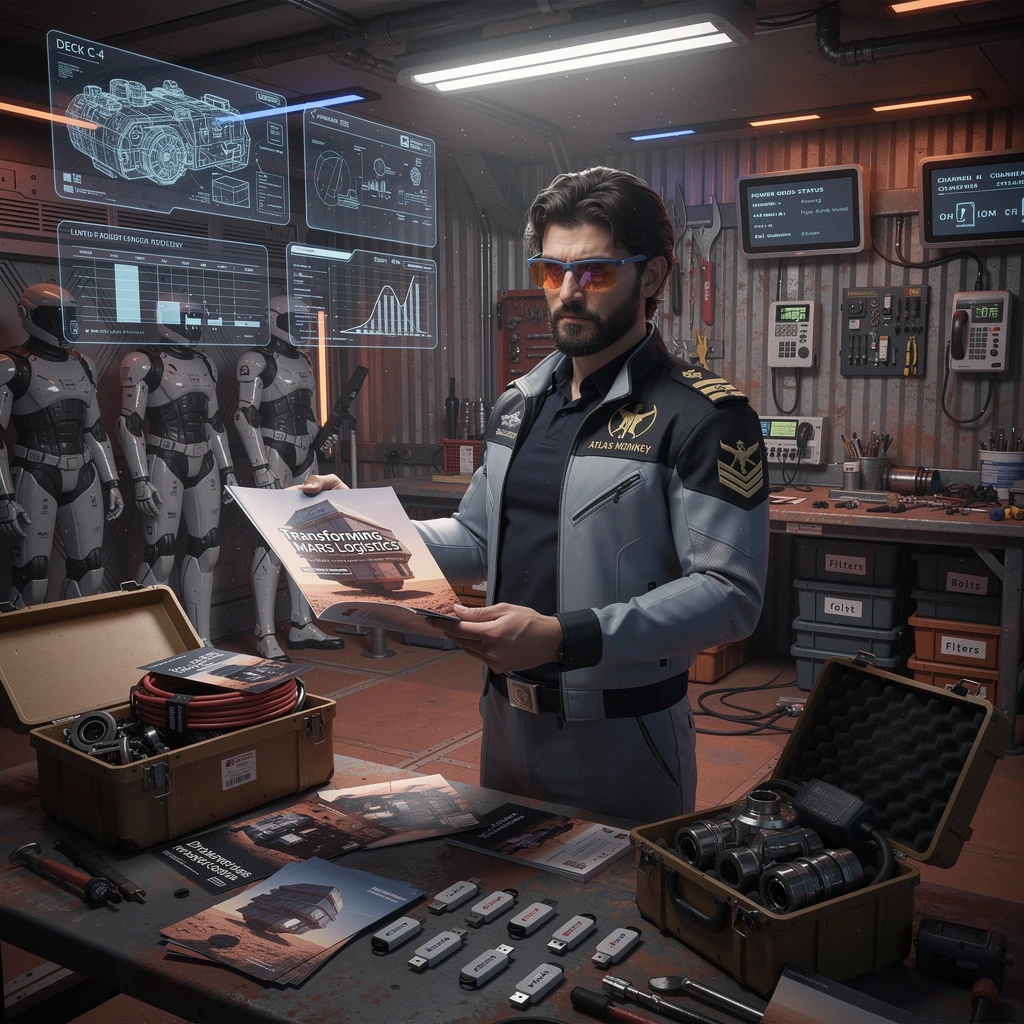
Supply Depot C, Sub-level 2. The cargo elevator shudders as the latest Earth shipment descends into the receiving bay. Fluorescent strips flicker against corrugated steel walls. MANIFEST SCAN: 847 items. PRIORITY FLAG: 12. UNCLASSIFIED: 614. The air smells of packing foam and desperation. Six days after the meteorite incident killed fifteen colonists, Earth corporations have discovered a tragedy they can monetize.
Captain Seuros stands at the sorting table, scanning crate labels with a handheld reader. Beside him, Tariq Mendez—former AI Procurement Lead at a Fortune 200 company, arrived Sol 829—is unboxing the first pallet with the reverence of someone opening Christmas presents.
Tariq: (reading a crate label with genuine excitement) “Captain, they responded fast. Look at this—MarsGuard AI Safety Platform, pre-configured for habitat monitoring. And here—” (pulls another manifest) “—twelve vendor proposals for autonomous emergency response systems. After what happened on Sol 826, this is exactly what we need.”
Seuros: (not looking up from his scanner) “What we needed was three centimeters of additional regolith shielding on Sector 7. Cost: forty hours of labor. What we got instead is eight hundred kilograms of marketing materials riding a resupply rocket that costs fourteen thousand dollars per kilogram to launch.”
(He pulls a glossy brochure from the first crate. The cover reads: “AI-POWERED METEORITE DEFENSE: Because Your Colony Deserves Better™”)
Seuros: “They spelled ‘meteorite’ wrong on the spec sheet.”
Tariq: (deflating slightly) “But the vendor reviews—I evaluated this platform myself back on Earth. Top quadrant in three analyst reports. Twelve enterprise references—”
Seuros: “Sit down, Mendez. Let me teach you something they don’t cover in procurement training.”
(He drags a crate to the center of the room and pulls out a datapad. On it: the full cargo manifest, sorted not by category but by sender.)
Seuros: “Every item on this manifest was sent by one of four species of parasite. They’ve been feeding on your profession since the first AI model hallucinated a confident answer. After Sol 826, they smelled blood—literally—and they shipped faster than our medical supplies.”
The First Parasite: The Regolith Merchants
(Seuros kicks open a crate stamped with MARSCORE SYSTEMS — PLATINUM TIER PARTNER.)
Seuros: “Crate one. MarsCore Systems. They make the LLM chips. The inference cards. The foundation models. They need you to believe that every problem is a nail, because they sell very expensive hammers.”
(Inside: a rack-mount inference server, pre-loaded with a 70-billion-parameter model and a promotional sticker that reads “Mars-Ready AI Infrastructure.”)
Seuros: “This server draws eleven kilowatts at peak. Our entire Sector 7 runs on fourteen. They’re asking us to dedicate 78% of a habitat sector’s power budget to run a model that—” (reads the spec sheet) ”—‘generates contextually appropriate emergency responses in natural language.’”
Tariq: “Natural language emergency responses could save—”
Seuros: “You know what saved the 185 people still breathing? A klaxon. A red light. And the sentence ‘RUN LEFT,’ which I screamed with my own lungs.”
(He pulls the promotional brochure from the crate.)
Seuros: “Read the deployment requirements.”
Tariq: (reading) “‘Requires stable network connectivity, climate-controlled server room between 18-24°C, and minimum three dedicated operators for monitoring and fine-tuning.’ Captain, we don’t have—”
Seuros: “We don’t have any of that. They know we don’t have any of that. They shipped it anyway because the invoice was signed on Earth by people who think ‘Mars deployment’ means a staging environment named ‘mars-prod.’”
(He shoves the crate aside.)
Seuros: “The regolith merchants don’t care if you find water ice. They care that you keep digging. Their quarterly earnings call doesn’t have a line item for ‘colonies saved.’ It has ‘units shipped.’”
The Second Parasite: The Dust Shifters
(Seuros opens the next pallet. Smaller boxes, each with different branding but suspiciously identical dimensions.)
Tariq: “These are the SaaS platforms I evaluated. HabitatMind, ColonyIQ, RedPlanet.ai, AresOps—”
Seuros: “Four names. One product. Watch.”
(He opens all four boxes. Inside each: an identical USB drive with different logo stickers, and a ‘Quick Start Guide’ that begins with ‘Step 1: Connect to the Internet.’)
Tariq: (staring) “These are… the same drive.”
Seuros: “Same white-label platform, four venture-funded wrappers. Every six months they rebrand. Last year HabitatMind was ‘AgriFlow AI’ selling to vertical farms. Year before that, ‘MediScan Pro’ for hospital workflows. They pivot faster than a solar panel tracking the sun, except the sun actually provides energy.”
Tariq: “But ColonyIQ raised forty million—”
Seuros: “To burn, not to build. The goal isn’t revenue, Mendez. The goal is runway. Raise, rebrand, claim a new vertical, raise again. They don’t need you to use the product. They need you to sign the contract before you realize the product is a login page connected to OpenAI’s API with a gradient background.”
(He lines up the four USB drives on the table.)
Seuros: “Your job on Earth—AI Procurement Lead—existed because these parasites needed someone to sell to. You didn’t evaluate software. You were a professional target. The entire analyst-report-to-procurement pipeline is a digestive system, and you were the stomach.”
Tariq: (long silence) “I had a team of six.”
Seuros: “You had a team of six stomachs.”
The Third Parasite: The Sim Runners
(The next crate is lighter. Seuros lifts it with one hand.)
Seuros: “Credentials.”
(Inside: a stack of laminated certificates, course access cards, and a letter addressed to “Mars Colony Leadership” offering a ‘Mars AI Readiness Certification Program—Enterprise License, 200 seats, urgent pricing expires in 48 hours.’)
Tariq: “Education is different. People need training to—”
Seuros: “People need to learn, yes. But these aren’t teachers. These are people who teach about chaos to remain standing in it.”
(He holds up a certificate: ‘Certified Agentic AI Workflow Architect — Level III.’)
Seuros: “This certification was created nine weeks ago. It certifies knowledge of tools released seven weeks ago. It will be obsolete in four weeks. The only constant is the $2,400 exam fee.”
Tariq: “You can’t just learn this stuff alone—”
Seuros: “Alone? I learned refrigeration from a Soviet-era manual I found in a supply crate on Sol 14. Printed in Cyrillic. I don’t read Cyrillic. But the diagrams worked, and our CO₂ scrubbers still run the cycle I reverse-engineered from those diagrams. Eight hundred sols later.”
(He drops the certificate stack into the recycler bin.)
Seuros: “The real educators—the ones worth listening to—don’t sell certifications. They write documentation. They record their failures. They open-source their solutions. They don’t put a countdown timer on knowledge.”
Tariq: “How do you tell them apart?”
Seuros: “Easy. The real ones have calluses. Metaphorical or literal. They’ve shipped production systems that woke them up at 3 AM. The parasites have slide decks. Check the hands, Mendez. Always check the hands.”
The Fourth Parasite: The Orbit Watchers
(The last section of the pallet. A sealed diplomatic pouch with an official Earth Government stamp.)
Seuros: (reading) “‘Mars Colony AI Governance Framework v2.1 — Preliminary Draft for Public Comment.’ Three hundred and forty-seven pages.”
Tariq: “Governance is important. After fifteen people—”
Seuros: (quiet, dangerous) “Don’t. Don’t you use those fifteen people to justify a document written by someone who has never held a pressure gauge.”
(He opens the framework to a random page.)
Seuros: “‘Section 14.3: All autonomous systems must undergo a mandatory 90-day review period before deployment in life-critical infrastructure.’ Ninety days. Our backup O₂ generator failed on Sol 4. We had six minutes. I wrote a patch in four. If I’d waited for a review period, the colony would be a graveyard with excellent documentation.”
Tariq: “But regulations—”
Seuros: “Are written by people whose careers are attached to the existence of regulation. Not to the existence of the people being regulated. This framework was authored by three policy directors who—” (checks the back page) “—list their qualifications as ‘extensive experience in AI governance consulting.’ Not one deployment. Not one system shipped. Not one alarm answered at 3 AM.”
(He puts the document down carefully, almost gently.)
Seuros: “I’m not against rules. We have rules. Rule one: don’t kill the oxygen. Rule two: test before you deploy. Rule three: if it breaks, you fix it—now, not after a committee meeting. Those rules were written in regolith dust by people who buried friends. They’re short because dead people don’t read long documents.”
(Tariq stares at the sorted wreckage. Four piles. Eight hundred kilograms of cargo. The useful items—actual spare parts, medical supplies, raw materials—fit in a single crate in the corner. Maybe forty kilograms total.)
Tariq: “So what was my job? Thirty-seven vendor evaluations a quarter. Twelve analyst reports. Eight proof-of-concepts. Four executive summaries. Two board presentations. All of it… feeding the parasites?”
Seuros: “Not all of it. Somewhere in that workflow, you touched real problems. You saw what broke. You knew which teams struggled. The tragedy isn’t that you evaluated vendors. It’s that the vendors were the point, not the problems.”
Tariq: “What do I do here? My entire skillset is navigating a parasite ecosystem that doesn’t exist on Mars.”
(The cargo bay door grinds open. MadBomber walks in, wiping hydraulic fluid from hands that have written code since 1976. He surveys the opened crates, the glossy brochures, the four identical USB drives still lined up on the table. His expression doesn’t change. He’s seen fifty years of this.)
MadBomber: “Let me guess. Earth sent help.”
Seuros: “Eight hundred kilos of it.”
MadBomber: (picking up the MarsCore inference server spec sheet, reading it in three seconds flat, dropping it) “Eleven kilowatts. On Mars.” (turns to Tariq) “You’re new. What did you do on Earth?”
Tariq: “AI Procurement Lead.”
MadBomber: (short laugh, no malice in it) “Son, I’ve been watching your industry invent itself since before you were born. In ‘84, they sold us CASE tools that would ‘eliminate programming.’ In ‘95, it was visual development—‘drag and drop, no code required.’ In 2005, SOA was going to solve everything. In 2015, microservices. Now it’s AI agents.”
(He picks up one of the four identical USB drives.)
MadBomber: “Same parasite, different host. The organism adapts, the pitch deck evolves, the invoice stays the same. I watched three generations of these creatures feed on NASA, then Boeing, then every consultancy that hired me. They don’t die. They rebrand.”
Tariq: “You’re saying nothing changes?”
MadBomber: “I’m saying the useful stuff always looks the same. Boring. Underfunded. Written by someone who needed it to work because lives depended on it. The Ada telemetry system I maintained at NASA—nobody sold that. Nobody marketed it. It just ran for twenty years because failure meant astronauts died.” (gestures at the crates) “None of this was built by people who lose sleep when it breaks.”
(He turns to Seuros.)
MadBomber: “Six days. Took them six days to monetize fifteen dead colonists. When Columbia broke apart in 2003, the first vendor pitch for ‘improved thermal protection monitoring systems’ hit NASA inboxes within a week. Seven astronauts dead, and someone’s sales team saw a pipeline opportunity.”
Seuros: (quiet) “Some things don’t change between planets.”
MadBomber: (to Tariq) “You want to be useful here? Real useful? Learn the difference between the people who build because they can’t sleep until it works, and the people who sell because they can’t eat until you buy. The first group never has brochures. The second group never has calluses.”
(He looks at his own hands—scarred, stained, fifty years of keyboards and soldering irons and patch cables mapped across the skin.)
MadBomber: “Aristotle—my AI—tried to turn the meteorite warning into a philosophy lecture. Almost got me killed. You know what I did after?”
Tariq: “Turned it off?”
MadBomber: “No. I kept it. But I added one rule: if the input contains ‘PRIORITY ALPHA,’ bypass everything. Pass it raw. No interpretation, no improvement, no comfort. Because sometimes the most philosophical thing you can do is scream ‘RUN’ and mean it.”
(He drops the USB drive back on the table and heads for the door.)
MadBomber: “Captain, I need the manifold pressure specs from the Sol 826 failure log. The real ones, not the AI-summarized version. I’m rebuilding Sector 7’s regolith shield by hand.”
Seuros: “Bay 4, locker 12. Paper copies.”
MadBomber: (already walking) “Paper. Good. Paper doesn’t rebrand.”
(Silence settles over the depot. Seuros gestures at the single useful crate.)
Seuros: “Forty kilograms out of eight hundred. Five percent signal. That’s actually better than most meetings I attended on Earth.”
(He hands Tariq the handheld scanner.)
Seuros: “New job. Same skill, inverted. Instead of finding vendors for problems, find problems for solutions. Inventory everything in this depot. Cross-reference with the failure logs from Sol 826. Every item that maps to an actual failure mode gets tagged green. Everything else gets broken down for raw materials.”
Tariq: “And the parasites? They’ll keep shipping.”
Seuros: “Let them. Cargo rockets cost fourteen thousand per kilo. As long as they keep padding the weight with brochures, we get free packing foam. Last month I insulated Greenhouse 3 with venture-capital-funded marketing materials. Best thermal rating we’ve measured.”
(Tariq almost smiles.)
Seuros: “Welcome to Mars, Mendez. Your job isn’t procurement anymore. It’s triage.”
(The cargo elevator groans. Another shipment descending. Another 847 items. Another five percent signal. The fluorescent lights hum their indifferent hymn. Somewhere in Sector 7, MadBomber is laying regolith by hand, the old way, the way that works.)
The parasites aren’t malicious. That’s the dangerous part. They believe their own pitch decks. The regolith merchant genuinely thinks more compute solves everything. The dust shifter truly believes this pivot will be the one. The sim runner honestly feels their certification helps. The orbit watcher sincerely wants to protect people. Sincerity doesn’t make them less parasitic. It makes them harder to spot, because they pass every honesty test. They’re not lying. They’re just wrong. And on Mars, wrong costs oxygen.
🔗Interstellar Communications
No transmissions detected yet.Be the first to establish contact!
Related Posts
Communications Array Chronicles: Sol 820 on Mars
In the flickering glow of Mars's communications hub, Maya Delgado receives another LinkedIn message promising '50K$ workflows' and 'digital transformation roadmaps.' Captain Seuros watches her delete them and delivers a brutal truth about dead-world thinking and the grifters still transmitting from a planet that no longer exists.
The Memory Leak Chronicles: Sol 847 on Mars
In the rec room's harsh light, survivors gather for a memorial. Nina from Hydroponics meets MadBomber from Emergency Command. Two generations of engineers—one who just learned AI can kill, one who spent 50 years forgetting it could. Together they draft the first law of Mars Engineering: Reality doesn't negotiate.
The Polite Apocalypse: Sol 826 on Mars
When a meteorite threatens to vaporize half the colony, the emergency warning passes through seven AI assistants. Each one makes it 'better'—more polite, more contextual, less alarming. By the time it reaches MadBomber through his philosophy-translation AI, imminent death has become a suggestion for mindful reflection. Captain Seuros discovers why comfort layers kill.